There’s a persistent myth in academic culture that success is purely a function of hours spent. The students who do best must have studied the most. Grind long enough and results follow.
The data doesn’t support this. Top students often study fewer hours than average students — they just use that time completely differently. Here’s what they actually do.
Try Duetoday free
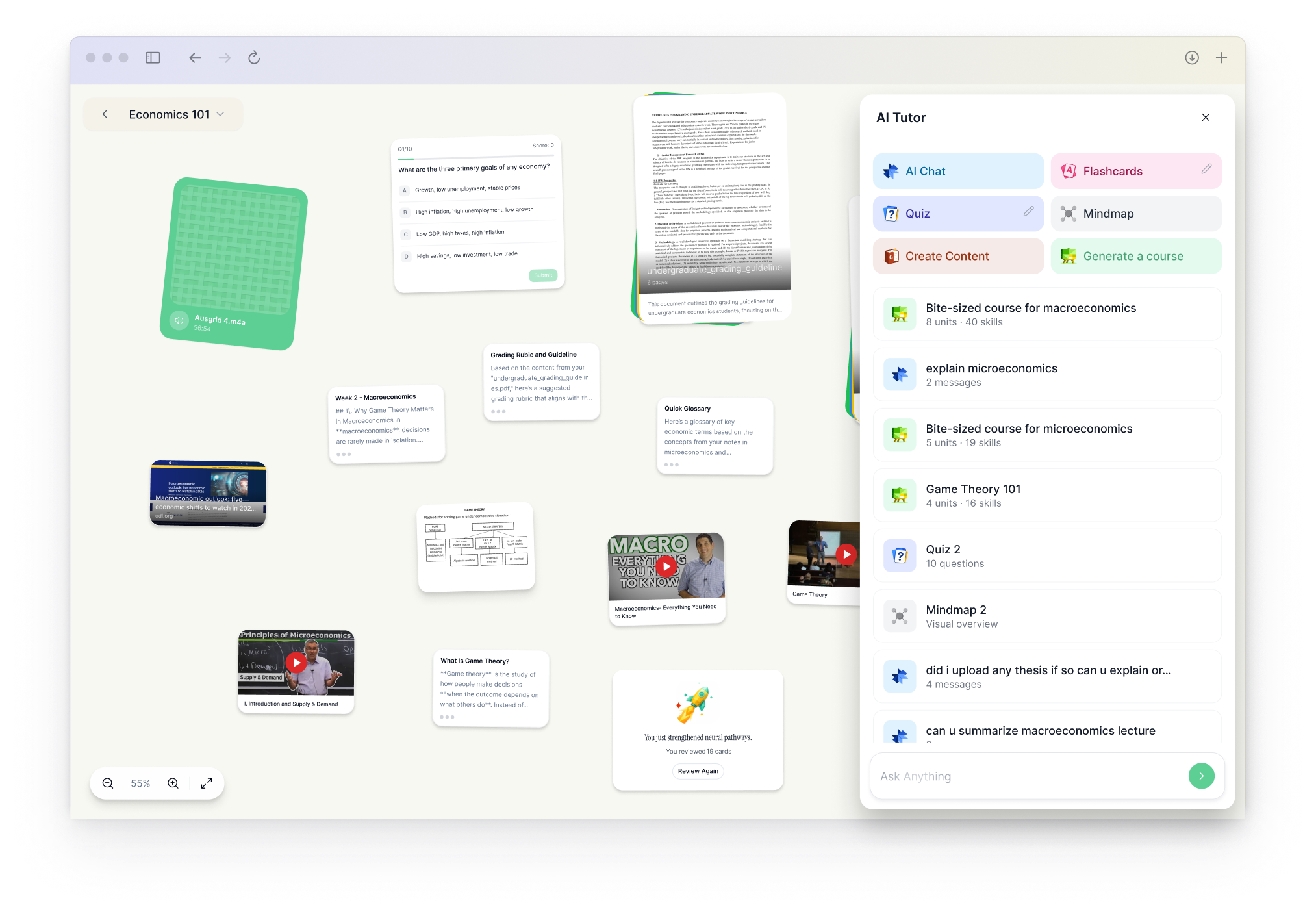
Turn your lectures, PDFs and YouTube videos into notes, flashcards and quizzes in seconds.
Get started free →1. They Know What’s Actually on the Exam
Before opening a single textbook, high-performing students ask: what does this exam actually test? They get the marking rubric, look at past papers, and read the learning outcomes. Then they work backwards.
This sounds obvious, but most students study the full course content equally and are surprised when certain topics appear more prominently than expected. Top students map the exam first, then allocate study time accordingly.
2. They Use Active Recall, Not Passive Review
The most consistently effective study technique is active recall — forcing yourself to retrieve information from memory rather than recognising it on a page.
High performers use flashcards, practice problems, and self-testing constantly. They close their notes and try to reproduce information before checking. The struggle is intentional.

Duetoday’s AI flashcard generator makes it easy to build active recall decks from your own lecture notes — without spending hours making cards manually.
3. They Don’t Re-Read — They Retrieve
Re-reading notes is the default study behaviour for most students. It’s also one of the least effective techniques identified in the cognitive psychology literature.
Top students read new material once, then immediately start testing themselves. They return to their notes only to fill specific gaps identified through retrieval practice.
4. They Study in Focused Blocks
Deep work requires sustained, uninterrupted attention. Students who perform well typically study in focused 60–90 minute blocks with no phone, no notifications, no background noise beyond perhaps white noise or instrumental music.
They also take real breaks between blocks — not 5-minute phone scrolls that keep them in the mental space of the work, but genuine disconnection.
5. They Process Lectures the Same Day
One of the most powerful habits of high-performing students is reviewing and processing lecture content the same day it’s delivered. Memory consolidation during sleep that night works on recently activated information — so notes reviewed the evening after a lecture stick significantly better than notes reviewed three weeks later.
This doesn’t require a long session. 20–30 minutes of reviewing the lecture, turning key points into flashcards using Duetoday, and flagging anything unclear is enough.
6. They Understand, Not Memorise
Top students in highly technical subjects spend time building conceptual understanding before attempting to memorise specifics. They ask “why does this work?” before “what is this?”
This matters because understanding creates a framework that specific facts attach to. Memorising facts without understanding why they’re true means the memory is fragile — a slightly different question can throw you entirely.
Use the AI tutor to probe your understanding. Ask it why something works, not just what it is. If you can’t explain it, you don’t know it well enough.
7. They Use Practice Exams Under Real Conditions
The single most predictive thing you can do for exam performance is simulate exam conditions repeatedly before the actual exam. Timed, notes-closed, full-length practice papers.
Top students treat practice exams seriously: they sit them at the same time of day as the real exam, don’t look anything up mid-question, and do a full review of every wrong answer afterwards.
Duetoday’s quiz generator can generate practice questions from your uploaded course content, making it easy to create simulated exams from your actual syllabus.
8. They Sleep and Exercise
This isn’t soft advice — it’s mechanistic. Sleep is when memory consolidation happens. Exercise increases BDNF (brain-derived neurotrophic factor), which improves memory formation and cognitive function.
Students who consistently get 7–8 hours of sleep and exercise regularly outperform those who sacrifice both for study time. Top students treat sleep like a performance variable, not a lifestyle luxury.
9. They Have a System, Not Just Intentions
Most students “plan to study” — top students have a specific system: which subjects on which days, what type of study in each session, when flashcard reviews happen, how they process new lectures.
A system removes decision-making from each study session, which means less procrastination and more automatic follow-through.
10. They Start Early
The compounding effect of spaced repetition means that the earlier you start reviewing material, the less total time you need as exams approach. Top students use spaced repetition throughout the semester rather than cramming at the end.
FAQ
Q: Do top students never cram? A: Most do occasionally, especially for less important assessments. The difference is they cram as a last resort, not a primary strategy.
Q: How many hours do top students typically study? A: Research on this is mixed, but quality consistently outweighs quantity. A focused 3-hour session with active recall typically produces better outcomes than 6 hours of passive re-reading.
Q: Can these habits be learned, or are top students just naturally better? A: These are learnable habits, not innate traits. The research on deliberate practice shows that study technique is far more malleable than most students believe.
Q: What’s the single biggest change a struggling student can make? A: Replace passive re-reading with active recall. It’s the highest-impact single change and requires no additional time — just a different approach to the same study sessions.
Q: How does AI fit into studying smarter? A: AI dramatically reduces the time spent on low-value tasks like making flashcards, summarising readings, and organising notes — freeing up time for high-value activities like retrieval practice and practice exams. Duetoday is built specifically for this workflow.