If you’ve ever spent three hours re-reading your notes the night before an exam and still blanked on half the questions, you’ve experienced the passive reading trap. It feels productive. It isn’t.
Active recall is the alternative — and the research consistently shows it produces dramatically better results. Here’s everything you need to know.
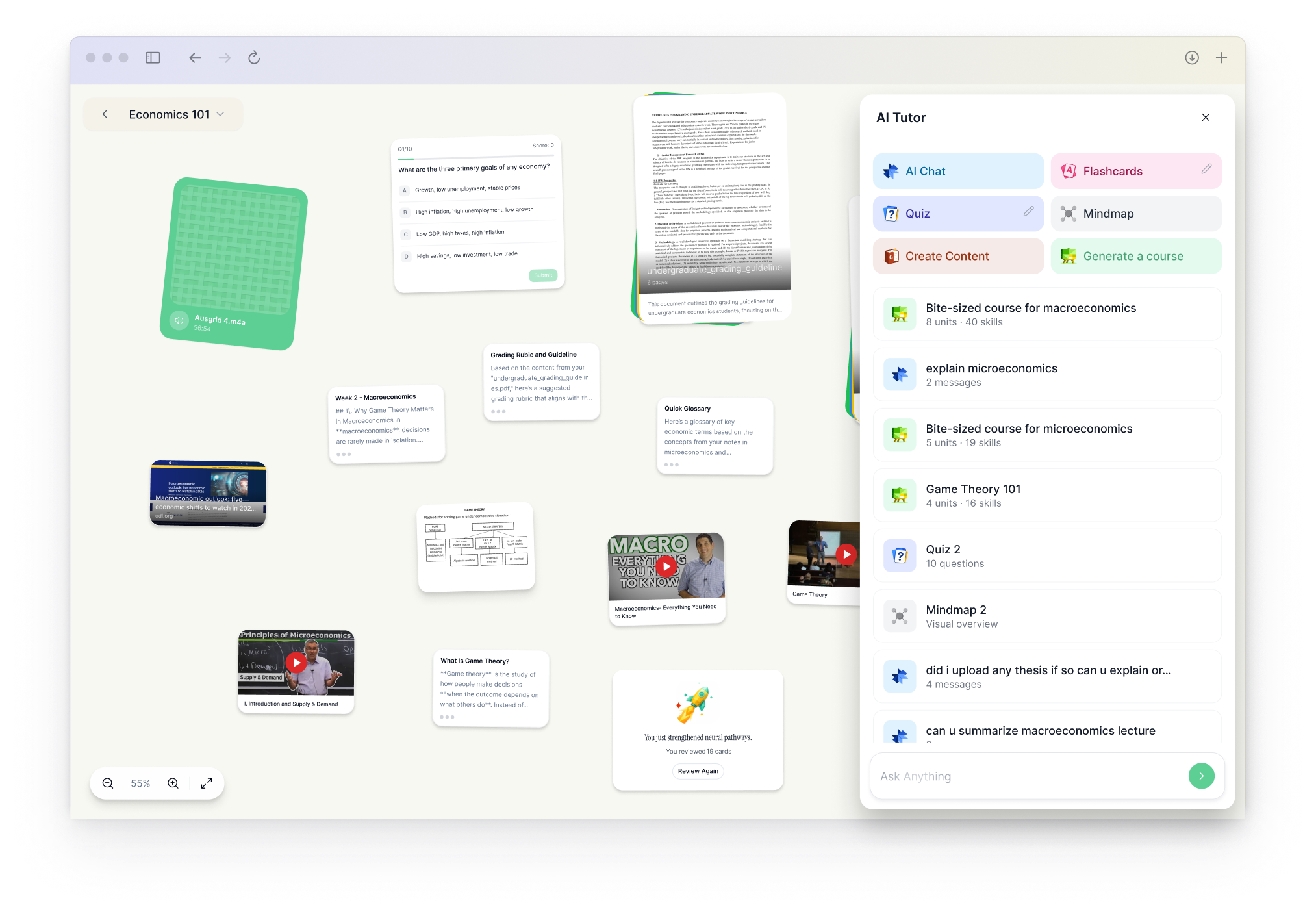
Try Duetoday free
Turn your lectures, PDFs and YouTube videos into notes, flashcards and quizzes in seconds.
Get started free →What Is Passive Reading?
Passive reading is what most students default to: reading your textbook, going through lecture slides, re-reading your notes, highlighting things. It feels like studying because you’re engaged with the material. But your brain is mostly in recognition mode — you’re identifying familiar information, not retrieving it from memory.
The problem is that exams test retrieval, not recognition. You’re not given the notes and asked to say “yes, this looks familiar.” You’re given a question and asked to produce an answer from scratch. Passive reading doesn’t train that muscle.
What Is Active Recall?

Active recall means forcing yourself to retrieve information from memory before you see the answer. The most common forms are:
- Flashcards — you see a prompt and try to recall the answer before flipping
- Practice questions — you answer questions with notes closed
- The blank page method — you write down everything you remember about a topic before checking your notes
- Teaching — explaining a concept to someone else from memory
The act of retrieval itself strengthens the memory trace. Every time you successfully recall something, the neural pathway gets stronger. Every time you struggle and then see the answer, the gap becomes memorable.
The Research
The evidence for active recall over passive re-reading is overwhelming.
A landmark 2006 study by Roediger and Karpicke found that students who used retrieval practice (active recall) retained 50% more information after a week than students who spent the same time re-studying. A 2011 follow-up showed similar effects across different types of content.
This is sometimes called the testing effect: being tested on material improves retention of that material more than studying it again does.
Why Students Keep Defaulting to Passive Reading
If active recall is so much better, why do most students re-read their notes?
It’s easier. Passive reading requires almost no cognitive effort. Active recall is genuinely hard — retrieving things you’re uncertain about is uncomfortable.
It feels productive. Re-reading fills time and feels like progress. The blank page method can feel like you’re failing when you can’t remember things, even though that struggle is exactly what’s making the learning stick.
It’s lower stakes. When you read and recognise something, you can tell yourself you know it. Active recall reveals what you don’t know, which is useful but uncomfortable.
How to Switch to Active Recall
1. Use flashcards properly
Flashcards only work as active recall if you actually try to retrieve the answer before flipping. Don’t glance at the front, decide you probably know it, and flip straight away. Cover the answer, say it out loud, then check. The effort matters.
Duetoday’s AI flashcard generator creates cards directly from your lecture notes and PDFs, so you don’t waste time making them manually.
2. Do practice questions with notes closed
Most students do practice questions with their notes open “just in case.” This turns retrieval practice into recognition practice and dramatically reduces the benefit. Do the full question first, then check.
Duetoday’s AI quiz generator can generate practice questions from any uploaded content, including your own lecture slides and notes.
3. The blank page method
After a lecture or study session, close everything and write down everything you can remember. Don’t structure it — just dump. Then open your notes and see what you missed.
The gaps you discover are your actual study targets. Re-read those sections, then try the blank page again.
4. Teach someone else
Explaining a concept to someone else from memory is one of the most powerful forms of active recall. Use a study partner, talk to an AI, or even explain things to yourself out loud.
Duetoday’s AI tutor is useful here — you can explain a concept to it and ask it to correct any errors or fill gaps in your explanation.
Finding the Right Balance
Active recall doesn’t mean never reading your notes again. The typical flow should be:
- First pass: Read/listen to the material to get it into your head
- Second pass: Active recall — flashcards, practice questions, blank page
- Targeted re-reading: Go back to the specific things you couldn’t recall
- Final pass: Active recall again on your weak areas
The ratio should be roughly 70% retrieval practice to 30% input. Most students have it backwards.
FAQ
Q: Is re-reading ever useful? A: Yes — for your first encounter with new material, and for targeted re-reading of specific things you couldn’t recall during active recall sessions. It’s not useful as a primary revision strategy.
Q: How long should an active recall session be? A: 30–60 minutes is typical. Active recall is cognitively demanding, so sessions feel shorter and harder than passive reading sessions. That’s normal and expected.
Q: What if I can’t remember anything during active recall? A: That’s fine — it means the exercise is revealing real gaps. Read the answer, understand it, wait 20 minutes, and try again. The struggle is the learning.
Q: Does active recall work for subjects like maths or coding? A: Yes — for maths, do problems from memory rather than following worked examples. For coding, write the solution before looking anything up. The principle is the same: retrieval under conditions that approximate the actual test.
Q: How many flashcards should I make per subject? A: Focus on quality over quantity. 40–80 well-targeted cards covering the key concepts will serve you better than 300 cards that include trivial details. AI flashcard generators like Duetoday are good at identifying which concepts deserve cards.