You’ve probably had this experience: you study something, feel like you know it, and then two weeks later you can barely remember it. This isn’t a personal failing. It’s how human memory works — and once you understand the mechanism, you can work with it instead of against it.
Spaced repetition is the study technique built around how memory actually functions. Used correctly, it’s the closest thing to a cheat code for long-term retention.
Try Duetoday free
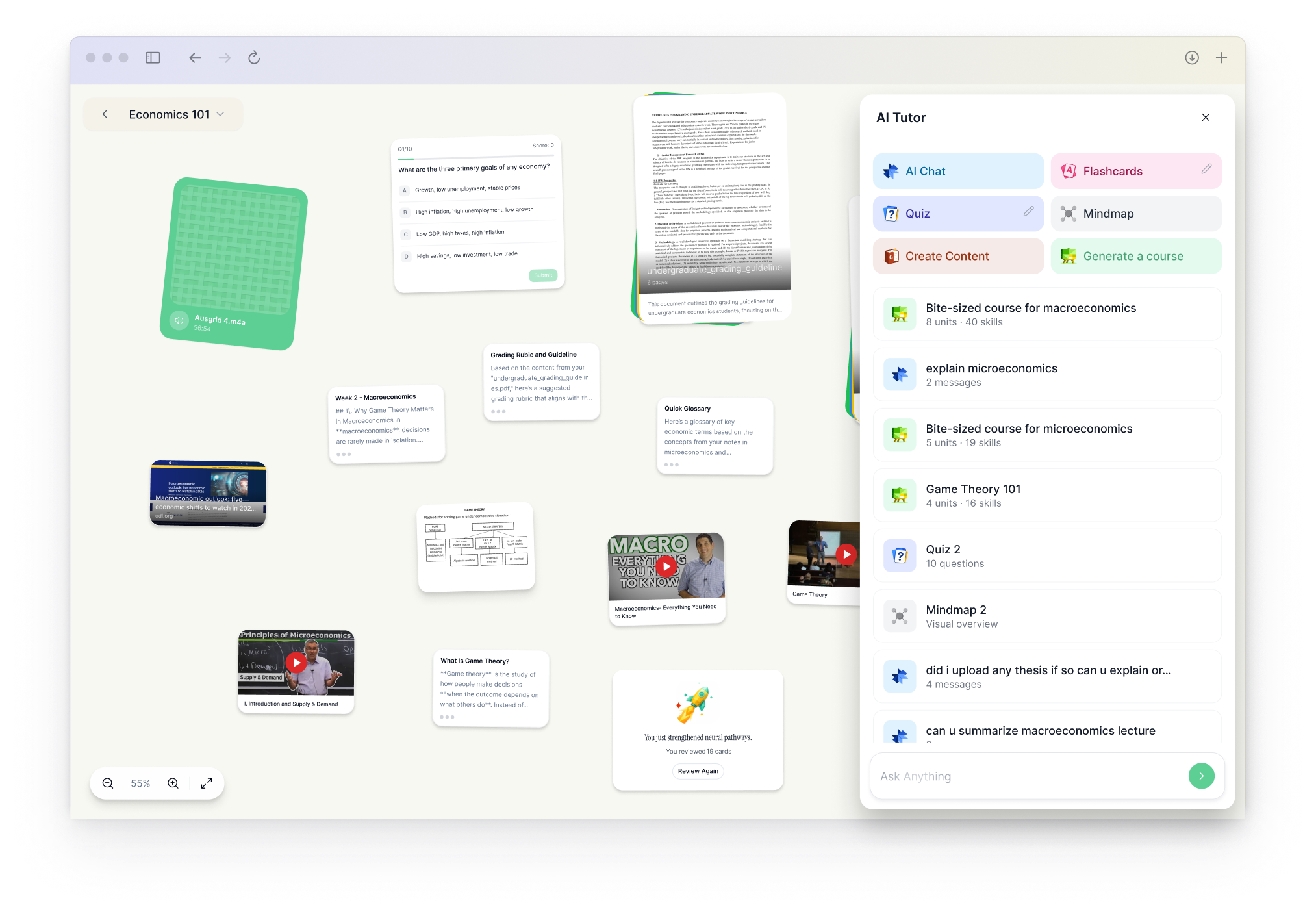
Turn your lectures, PDFs and YouTube videos into notes, flashcards and quizzes in seconds.
Get started free →The Forgetting Curve
In the 1880s, German psychologist Hermann Ebbinghaus conducted experiments on himself, memorising lists of nonsense syllables and then testing how well he retained them over time. His findings — known as the forgetting curve — showed something striking:
Without review, people forget roughly 50% of new information within a day, and 80% within a week.
This isn’t because the information is gone. It’s because the memory trace hasn’t been reinforced enough to persist. Memory is dynamic: connections that aren’t used weaken over time.
How Spaced Repetition Fights the Forgetting Curve
The key insight from Ebbinghaus’s research was that each time you successfully recall information, the forgetting curve resets — and flattens. After the first review, you forget more slowly. After the second, even more slowly. By the fourth or fifth spaced review, the information is in long-term memory and barely requires maintenance.
Spaced repetition means reviewing material at increasing intervals:
- First review: 1 day after learning
- Second review: 3 days after the first
- Third review: 1 week after the second
- Fourth review: 2 weeks after the third
- Fifth review: 1 month after the fourth
This schedule front-loads the effort and dramatically reduces the total study time needed for long-term retention compared to massed practice (cramming).
Spaced Repetition vs Cramming
Cramming works for short-term recall. If you need to remember something for an exam tomorrow, intensive review the night before will get you through it. But the forgetting curve means that information is largely gone within a week.
Spaced repetition takes more total calendar time but less total study time. And the information actually sticks.
For professional subjects — medicine, law, engineering — where you need to build on earlier knowledge throughout a multi-year degree, spaced repetition isn’t optional. It’s the only approach that works at scale.
The Algorithm Behind Modern Spaced Repetition
You don’t need to manually calculate when to review each piece of information. That’s what software is for.
The most famous spaced repetition algorithm is SM-2, developed by Piotr Woźniak. It adjusts the interval between reviews based on how confidently you recalled each item. Items you found easy get longer intervals. Items you found hard get shorter ones.

Duetoday’s flashcard system builds spaced repetition into your review sessions automatically. Cards you mark as difficult come up more frequently. Cards you consistently get right come up less often. The system optimises your review time without you needing to think about it.
How to Actually Implement It
Step 1: Create your flashcard deck early
Spaced repetition requires time. You can’t do it the night before an exam. Start building and reviewing cards at the beginning of each week of the semester.
With Duetoday, you can upload your lecture slides each week and generate flashcards automatically — so the deck builds itself as the course progresses.
Step 2: Review daily, but briefly
The power of spaced repetition comes from consistency, not duration. 15–20 minutes of flashcard review every day is far more effective than two hours every weekend.
Build it into a fixed slot: morning coffee, commute, right after dinner. The trigger makes it automatic.
Step 3: Be honest about what you know
When you review a card and you weren’t sure of the answer, mark it as difficult even if you got it right. The system needs accurate feedback to work.
Step 4: Trust the algorithm
You’ll notice that cards from weeks ago start coming back up for review. This is the system working correctly. Review them even if you feel like you know them — confirming retention is part of what keeps the forgetting curve flat.
Combining Spaced Repetition With Active Recall
Spaced repetition is a scheduling strategy. Active recall is a retrieval strategy. Combined, they’re extremely powerful.
The workflow is simple: use active recall during each review session (try to answer before seeing the card’s answer), and use the spaced repetition algorithm to determine when each card comes up. Duetoday’s system combines both automatically.
How Much Does It Actually Help?
Research by Cepeda et al. (2006) showed that spaced practice produces retention rates 50–200% higher than massed practice, depending on the retention interval required. For exams weeks away, the advantage is dramatic.
FAQ
Q: How is spaced repetition different from just reviewing notes repeatedly? A: Spaced repetition uses increasing intervals between reviews, informed by how well you recall each item. Re-reading notes repeatedly is passive and doesn’t adjust based on what you actually know or don’t know.
Q: Can I use spaced repetition for subjects that aren’t fact-based, like essay writing? A: Yes — use it for key concepts, argument structures, case studies, and examples. You won’t flashcard full essay arguments, but you can flashcard the building blocks: thesis positions, supporting evidence, counter-arguments.
Q: What if I start spaced repetition late — two weeks before exams? A: You’ll still benefit, but you won’t get the full compounding effect. Compress the intervals: review new cards after 1 day, then 2 days, then 5 days. It’s not optimal but it’s much better than cramming.
Q: How many cards can I realistically maintain with spaced repetition? A: Most students can comfortably maintain 50–150 active cards across all subjects with 15–20 minutes of daily review. Beyond that, review sessions start to feel unmanageable.
Q: Does spaced repetition work for language learning? A: It was originally developed partly for vocabulary learning and works extremely well for it. It’s one of the most effective approaches for building foreign language vocabulary and grammar retention.