Finals season is brutal. You’ve got weeks of lectures, hundreds of pages of reading, and somehow only a few days to pull it all together. The students who consistently perform well aren’t necessarily smarter — they just have better systems. And right now, the best system available is AI.
This guide walks you through exactly how to use AI to prepare for finals, from organising your materials on day one to the final review session the night before your exam.
Try Duetoday free
Turn your lectures, PDFs and YouTube videos into notes, flashcards and quizzes in seconds.
Get started free →Step 1: Centralise Everything Before You Start
The first thing most students get wrong about finals prep is that they start studying before they’ve organised what they need to study. You end up with half your notes in a notebook, half in Google Docs, some slides downloaded and some not.
Before you open a single flashcard or start a practice quiz, gather everything:
- Lecture slides and recordings
- Assigned readings and textbook chapters
- Your own handwritten or typed notes
- Any past papers or practice questions
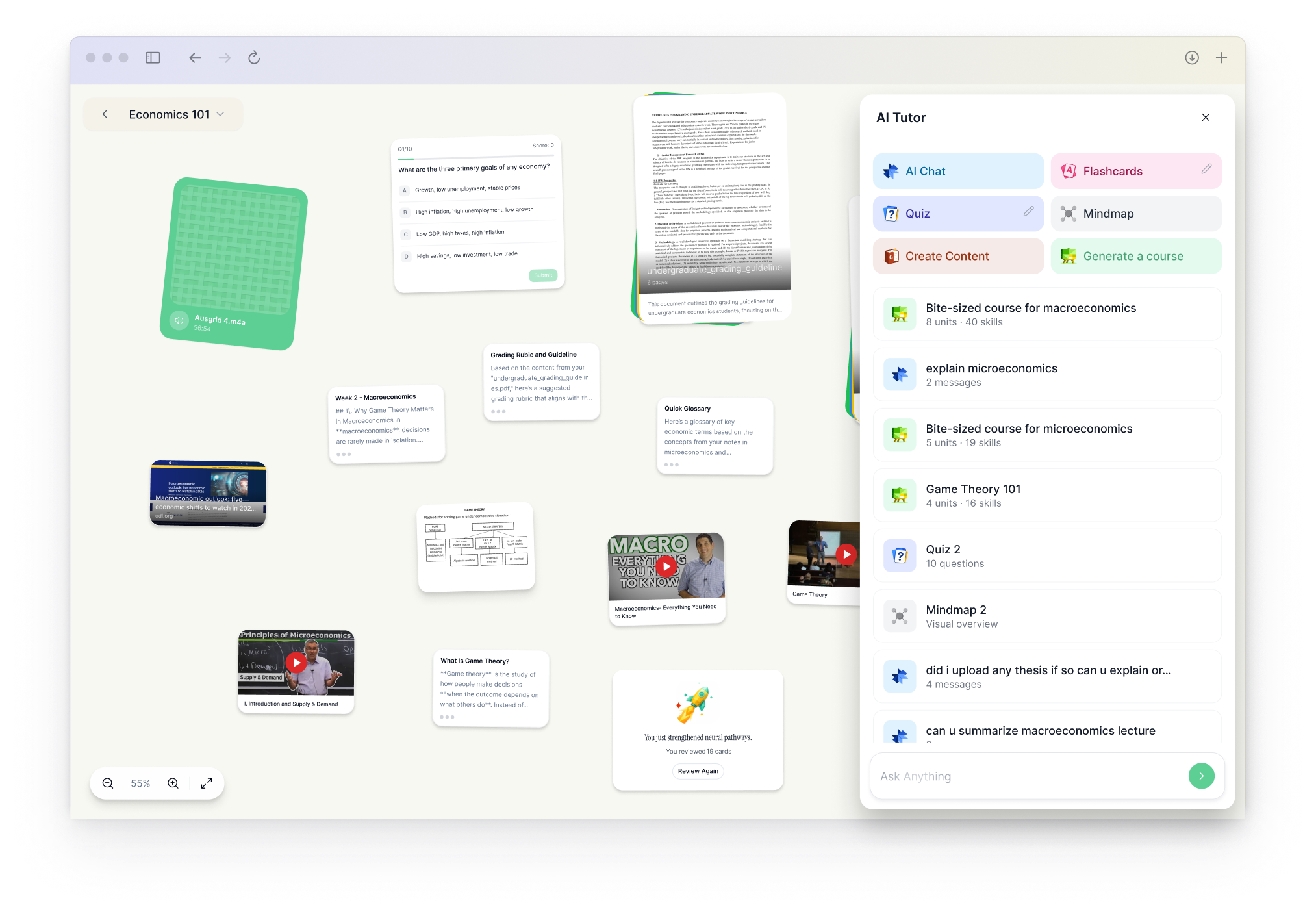
Upload all of it into one place. Duetoday lets you upload PDFs, lecture audio, YouTube videos, and text all in one workspace. Once everything is in one place, AI can actually work across all of it.
Step 2: Generate a Master Summary of Each Topic
Don’t start by trying to memorise individual facts. Start at the 10,000-foot view: what are the main topics, and how do they connect?
Use an AI tool to generate structured notes from each lecture or reading. With Duetoday’s AI lecture note taker, you can drop in a recorded lecture or a set of slides and get back clean, structured notes with headings, key concepts, and definitions — in under a minute.
Do this for each unit or week of the course. You’ll quickly spot which areas are well-covered in your notes and which have gaps.
Step 3: Build Your Flashcard Deck
Once you have your master notes, the next step is active recall — and the most efficient way to do active recall at scale is flashcards.
The problem with making flashcards manually is it takes hours, and you often end up making cards for things you already know rather than things you actually need to review.

AI flashcard generation solves both problems. Duetoday’s AI flashcard generator reads your notes or uploads and automatically identifies the concepts, definitions, processes, and facts most likely to appear in an exam. You can have a full flashcard deck ready in minutes.
Focus your deck on weak areas
After your first pass through the deck, sort the cards. Mark anything you got wrong or felt uncertain about. In subsequent sessions, focus almost entirely on these weak cards. This is the core principle behind spaced repetition — more review on the things you don’t know.
Step 4: Take Practice Quizzes
Flashcards test individual facts. Practice quizzes test whether you can apply knowledge — which is what finals actually require.
Duetoday’s AI quiz generator can turn any set of notes or uploaded material into a full multiple-choice or short-answer quiz. Set a time limit to simulate exam conditions. Review every wrong answer and understand why you got it wrong before moving on.
Aim to take at least two full practice quizzes per subject in the week before finals. Your score will go up dramatically between the first and second attempt.
Step 5: Use the AI Tutor for Anything You’re Stuck On
There will always be concepts that don’t click. Maybe it’s a particular law case, a biochemical pathway, or an economic model. This is where the AI tutor changes everything.
Rather than re-reading the same paragraph three times or waiting for office hours, you can ask the AI tutor to explain the concept in a different way, give you an analogy, walk you through an example, or quiz you on it until it sticks. It’s trained on your uploaded materials, so the explanations are specific to your course.
Step 6: The Final 48 Hours
The week before finals is for building knowledge. The final 48 hours is for consolidation, not new learning.
- 48 hours out: Full practice quiz for every subject. Note weak areas.
- 24 hours out: Review flashcards on weak areas only. Re-read your summary notes.
- Night before: One more pass through the flashcards. No new material. Sleep.
Sleep is non-negotiable. A well-rested brain retrieves information significantly better than an exhausted one.
Step 7: The Morning of the Exam
Eat something. Don’t cram. A quick 15-minute review of your summary notes is fine, but trying to learn new material the morning of an exam almost always backfires — it creates interference with what you already know.
If you’ve done the steps above in the weeks leading up to finals, you’ve already done the work. Trust the process.
Common Mistakes to Avoid
Re-reading notes without testing yourself. This feels productive but doesn’t actually move information into long-term memory. Always test, don’t just review.
Studying everything equally. Spend time proportional to how well you know something. Ten hours on material you already know is a poor trade.
Leaving it too late. AI speeds up study material creation dramatically, but it can’t manufacture time. Starting two weeks out is better than one.
Pulling all-nighters. The research is unambiguous: sleep deprivation tanks exam performance. One good night of sleep is worth more than three extra hours of cramming.
FAQ
Q: How early should I start using AI to study for finals? A: Ideally two to three weeks before your exam date. This gives you enough time to work through the material in spaced repetition sessions, which require multiple review cycles spread over days.
Q: Can AI tools help if I’ve missed a lot of lectures? A: Yes — this is actually one of the strongest use cases. Upload all the lecture slides and recordings at once, generate structured notes for each, and work through them systematically. It compresses the catch-up timeline significantly.
Q: Is it cheating to use AI to generate study materials? A: No. Generating flashcards, notes, and practice quizzes from your own course materials is a study technique, not academic dishonesty. The learning still happens when you review the materials. For more on this, see our post on whether using AI to study is cheating.
Q: What’s the best AI tool for studying for finals? A: A purpose-built study AI like Duetoday will outperform a general chatbot for exam prep. It’s designed specifically for the student workflow — uploading, summarising, generating flashcards and quizzes, and tutoring — rather than requiring you to prompt-engineer everything yourself.
Q: How many flashcards should I make per subject? A: Quality over quantity. 50 well-targeted flashcards that cover the key concepts in a module will serve you better than 200 cards that include things you already know. Let AI generate the initial deck, then prune it down to the cards that actually challenge you.